Before the Macintosh became a household name and defined the shape of personal computing, Apple Computer released a precursor that, looking back, seems less like a consumer product and more like a transmission from an alternate timeline: the Apple Lisa. In 1983, the Lisa was ahead of its time, startling, and unreal.
Up until it arrived, computing was strictly monochromatic and completely text-based. I was accustomed to the rhythmic clack of the VT100 terminal, and the glowing void of command-line prompts where every action required a precise string of syntax. If you wanted the computer to do something, you had to speak its language.
My first experience of the Lisa was my father bringing home a piece of paper printed on an early dot matrix printer that showed a series of overlapping geometric shapes, some filled with black, some hollow outlines, and some grey filled with an even grid of dots. Up until that point, I had only ever seen typewriter-like prints on what was called “Candy Stripe” paper -- words rudimentarily arranged on rolls of paper with perforations on the edges.
That day, everything changed. My father was an English and Art professor at Brown who was involved with a technology experiment that later, through a series of convolutions, turned into what is now known as The Victorian Web. That experiment made it possible for him to bring home a Lisa.
A Paradigm Shift in Pixels
If holding the printed page was surprising, interacting with the Graphical User Interface (GUI) was even more stunning. For the first time, there were objects on screen that could be grabbed and moved, such as windows, folders, and pull-down menus, using a strangely intuitive little device called a "mouse.” The Macintosh would successfully commercialize this formula roughly a year later, but the Lisa was the pioneer that proved the mouse and metaphoric interface worked outside of research labs like Xerox Parc.
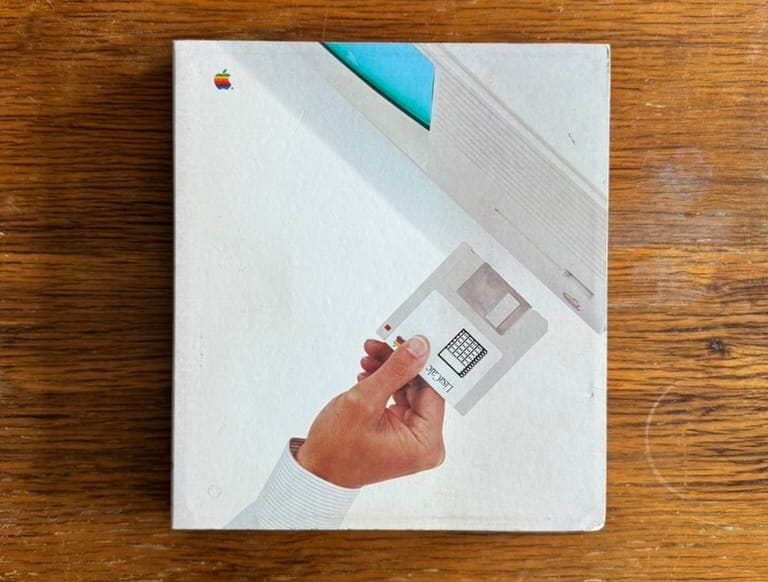
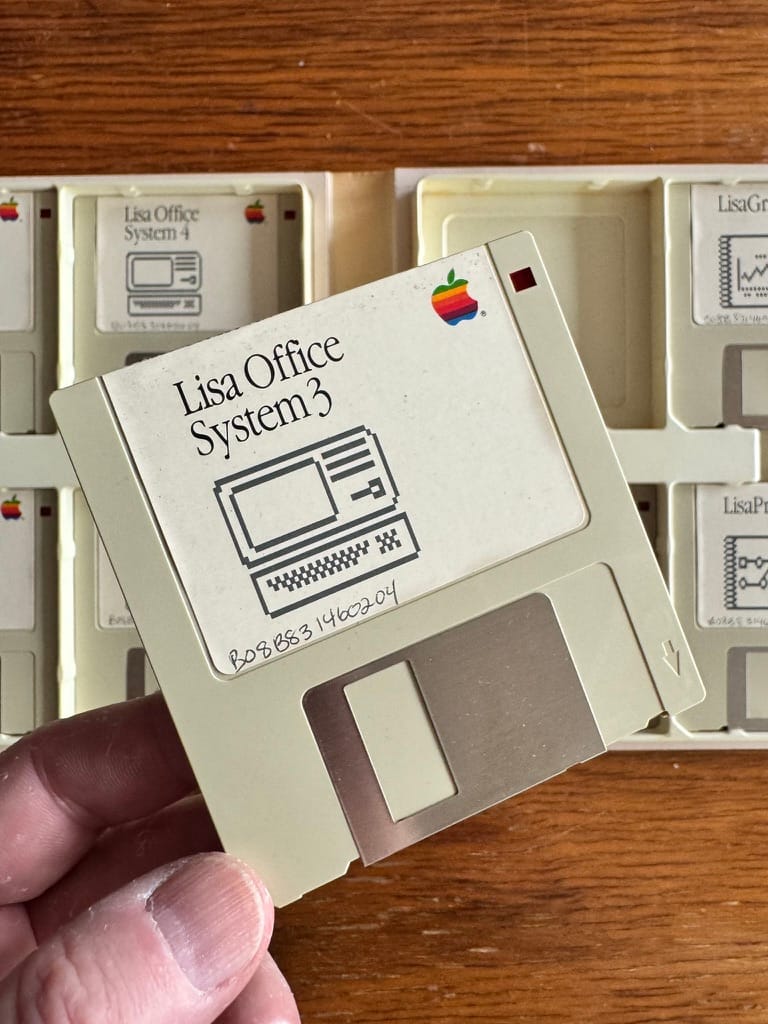
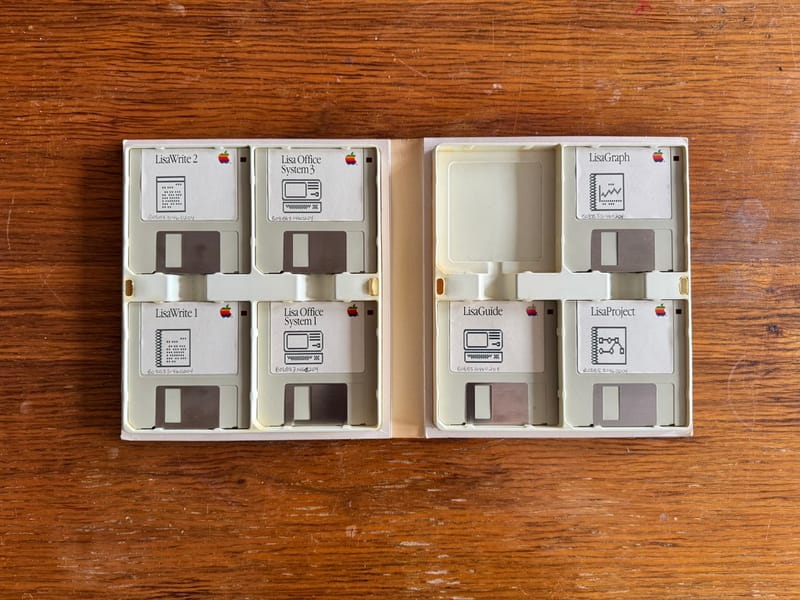
Looking back at the physical artifacts of that era, like the box of Lisa software floppy disks, the first signs of efforts to bridge the gap between physical offices and digital spaces emerge. Susan Kare’s icon design work imbued the Macintosh with more personality, humor, and character; the contrast is striking between her warm welcoming designs and the stiff coarseness of these early Lisa icons.
The Artifacts of Innovation
Holding one of those disks today is a physical reminder of how massive that leap forward felt. The icon on the label was a simple line drawing of the computer itself, an interim design of what was to come.
The Lisa did have a staggering initial price tag of nearly $10,000, leaving the lighter, cheaper Macintosh to claim the crown of history. But for a brief moment, thanks to a dumb twist of luck, the cutting edge of human-computer interaction sat in my father’s study, and changed the way I looked at computers, screens, and design forever.
The Coming Dawn of Desktop Publishing
In the years following my encountering the Lisa, I attended a summer camp (Buck's Rock) that had an exceedingly unusual workshop, the Print Shop, devoted to handset letterpress printing. I spent my days laboriously assembling tiny lead letters into lines, separated by slim strips of lead (technically leads and slugs).
I also devoted days to a neighboring shop (the Publications Shop) in which we cut long strips of text (galleys) and pasted them (with rubber cement) into gridded pages, imaged them onto printing plates (usually paper but occasionally metal), and ran them on offset presses.
But the Lisa was like a portal into the future, it offered a glimpse foreshadowed into the future, a future I did not encounter for years.
When I did encountered the Macintosh, it was a like an old friend, the other end of a magical portal through time, now mainstreamed and widely available. And with it I was able to use tools like PageMaker and laser printers, and later QuarkXPress, FreeHand, Photoshop, and more all to realize the possibilities at which the Lisa had hinted.
Epilogue
The Lisa computer itself sits in a strange, half forgotten place. Sharing the same name as Jobs’ poorly treated daughter, whose he devoted years to disavowing, the Lisa computer was ignored, while Jobs denied it was named after her — admitting the truth only late in life.